

X-ray fluorescence (XRF) is a commonly used technique for elemental analysis. Compared to other technologies, XRF is non-destructive, easy to use, and requires minimal sample preparation. Micro-XRF applies the same principles as XRF but on a much smaller (micro) scale.
Challenge
To perform micro-XRF, a micron-sized beam of X-rays is required to hit the sample. This small beam can be achieved using a conventional pinhole aperture or X-ray optics. One challenge faced with using a conventional pinhole aperture is that it will block a large portion of the X-rays emitted from the source, thereby reducing the number of X-rays hitting the sample, resulting in much lower fluorescence. Another challenge is that the output beam from the pinhole will be divergent, resulting in a larger excitation area on the sample. Both challenges impact the detection sensitivity and spatial resolution of micro-XRF analysis.
Solution
It has been proven that the use of polycapillary focusing optics greatly enhances micro-XRF analysis. Polycapillary optics offer many benefits, such as a large collection solid angle, high flux density, and a focused micron sized beam. Polycapillary optics transmit a polychromatic beam that can achieve a focused spot size as small as 5μm, FWHM at Rh Kα energy (20.2keV) with intensities greater than 107 photons/second. These performance attributes provide a great impact to micro-XRF across many different applications. Figure 1 is an example of a mapping application. To further investigate how polycapillary optics can enhance XRF, let’s look at a real-world application using a custom XOS polycapillary optic in the Mars 2020 rover to help seek evidence of past life on Mars.
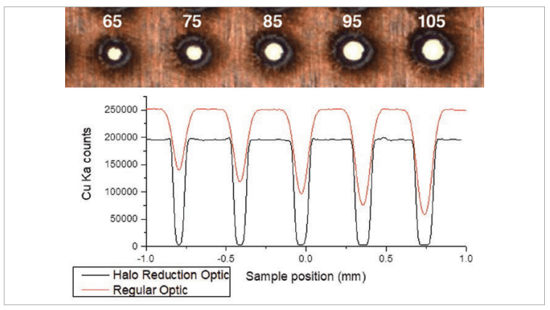
Figure 1: 1D XRF scan (bottom) of a copper PCB sample (top), using both
a regular and a halo reduction polycapillary optic, each with a 15μm focal
spot. The high-energy halo effect is clearly visible with regular optic while it
is eliminated with the halo reduction optic.
Product Highlight:
Polycapillary Optics
Improve X-ray analysis performance and capability
A polycapillary optic captures a large solid angle of X-rays from an X-ray source and redirects them to a micron-sized focal spot or a highly collimated beam. The X-ray intensity achieved with such optics is a few orders of magnitude higher than that obtained with conventional pinhole collimators, contributing to the significantly improved X-ray analysis performance in detection sensitivity, spatial resolution, measurement speed, and precision. XOS optics are widely used in commercial instruments and customized X-ray analysis systems for various industrial and research applications in the fields such as microelectronics, semiconductor
manufacturing, pharma, and life sciences.

XOS Polycapillary optics and the Mars 2020 rover
The new Mars rover, scheduled for launch in July of 2020 by the National Aeronautics and Space Administration (NASA), will include a micro-X-ray fluorescence (micro-XRF) instrument called “PIXL,” which stands for “Planetary Instrument for X-ray Lithochemistry.” PIXL, which houses the XOS polycapillary optic on the rover, will be mounted at the end of the rover’s robotic arm and is designed to provide fine-scale identification of the elemental composition of rocks and soils on Mars. It is one of seven instruments on the Mars 2020 rover that will work to seek evidence of past life on Mars. The following is an excerpt taken from the Proceedings of the International Symposium on Artificial Intelligence, Robotics and Automation in Space where Abigail Allwood, an astrobiologist at NASA’s Jet Propulsion Laboratory in Pasadena, California, talks about PIXL and its role in the Mars 2020 rover.
How XOS and Micro-XRF Contribute to the Mars Mission
PIXL will contribute several things to the Mars 2020 mission. PIXL will examine the abundance and distribution of chemical elements at sub-millimeter scales in rocks and soils. PIXL uses micro-XRF spectroscopy and a camera–optical fiducial system to correlate chemistry with fine-scale visible textures. PIXL can measure the composition of individual grains, cements, concretions, veins, layers and crystals. PIXL builds on previous rover-based measurements of chemistry performed by the alpha-particle X-ray spectrometer (APXS) that was deployed on the Mars Science Laboratory and Mars Exploration Rover missions, by providing increased spatial resolution and sensitivity. Essentially, PIXL is a petrology investigation—an integrated study of rock composition and texture and microstructure. The measurements performed by PIXL will enable very detailed insights to the processes of rock formation and alteration, which is important for understanding past habitability and the potential for biosignature preservation. PIXL fits well with the other surface geology instruments aboard the 2020 rover: SHERLOC, an arm-mounted close-up survey of organics and minerals using UV fluorescence and Raman; Supercam, a mast-mounted remote survey of elements and minerals using infrared spectroscopy, laser-induced breakdown spectroscopy, and Raman spectroscopy; and the Mastcam-Z, which is a mast-mounted camera. We are very excited about the capabilities of the whole instrument suite. We will be able to access a whole new level of detail about Mars geology and astrobiology.
PIXL’s Search for Life-Indicating Biosignatures
PIXL will play different roles depending on the type of biosignature in question. In terms of outright detection, PIXL is best suited for chemical biosignatures—a broad term applied to any kind of elemental pattern or feature that may originate from microbial metabolism. An example is vanadium-enriched “reduction spots”—tiny dark spots in the reduced zone of red beds, where local enrichments in vanadium and other biologically interesting elements are thought to reflect biologic processing. PIXL will also enable interpretation of geology to guide the rover to promising locales for biosignatures. It will then document the geochemical characteristics of any other kinds of potential biosignatures that are detected (for example, by measuring the chemical composition of layers in a stromatolite), or measure the geochemistry or texture of organic deposits. Lastly, it will establish geologic context to help with interpretation of potential biosignatures discovered on Mars or in samples that are returned to Earth.
PIXL Specs: Sensitivity, Spectra Acquisition, and Speed
PIXL can measure major and minor elements in around 5–20 seconds. Trace-element detection (tens to hundreds of parts per million) takes a few minutes to around 30 minutes. We have two very effective ways of balancing sensitivity and time. One way is by summing spectra. This involves grouping spectra together that occur on a given rock component. For example, if a rock has light layers and dark layers, and we have 100 ten-second dwells on each, we sum all the spectra together from light layers and get a bulk analysis for light layers with sensitivity equivalent to 1000 seconds. The other way is through autonomous recognition of different rock components to trigger long dwells. This is known as adaptive sampling. This approach uses an onboard algorithm to monitor spectra in real time and recognize when certain spectral thresholds are exceeded. The thresholds are established to enable recognition of when PIXL scans across a transition from one part of the rock into another, compositionally distinct part of the rock (such as pyroxene grains into sulfate grains).
Importance of High-Resolution Imaging in PIXL’s XRF Data Interpretation
The camera is critical for tying the measured chemistry to fine-scale texture and microstructure. Knowing which part of the rock (such as grain vs. cement or matrix vs. vein) a chemical composition relates to is essential for understanding the origin and significance of that measured composition. We will correlate the chemistry with the images by projecting a pattern of light beams onto the rock surface. The light pattern has a known geometric relationship to the X-ray beam, so we can determine the location of the X-ray beam very precisely on rough or flat surfaces, even though the beam is not visible.
Technical Challenges in Fortifying PIXL for Use on Mars
One of the biggest technical challenges is the high-voltage power supply for the X-ray tube. We have to generate 28 kV on the end of the rover arm in the ambient Martian environment, which has about the worst pressure for electrical breakdown. We have some of the best people in the business working on it. It’s also very challenging to achieve accurate, precise arm positioning. PIXL’s preferred standoff distance (~3 cm) is pretty close for a large rover arm with a bulky set of instruments on the end.
Additional Commercial Collaborations on PIXL Development
We have two key industry partners who have been working with us since PIXL’s inception in 2010. Moxtek is building the X-ray tube—a tiny, very low-power, side-window design developed for PIXL. It’s similar to their commercial miniature tubes but was developed by Todd Parker to meet our specific needs. XOS is providing a custom polycapillary X-ray focusing optic optimized for integration with the Moxtek tube. I believe that it may be the first time a polycapillary X-ray optic has been integrated with a miniature low power X-ray tube for a “portable” instrument application. Both partners have been outstanding to work with, and their support has been very important to the project’s success.”
Conclusion
The use of polycapillary optics has completely changed the analytical speed and accuracy of micro-XRF analysis, supplying accurate and reliable measurement results in just hours compared to the days-long wait of conventional approaches. Polycapillary optics can be used in many applications, including plating thickness, forensics, cultural heritage, and elemental mapping— such as on the Mars 2020 rover, where an XOS polycapillary optic will play a critical role in the search for past life on Mars after it lands in 2021.

.png?width=600&height=323&name=Blog%20Featured%20Image%20-%20600%20x%20323px%20(2).png)
.png?width=600&height=323&name=Technology%20Spotlight%20Monochromatic%20Micro%20X-ray%20Fluorescence%20(M%CE%BCXRF).png)