
Background
Biofuels are fuels produced from feedstocks such as vegetable oil, animal fat, used cooking oil, biomass, or a blend of these. They are not produced from fossil fuels, but rather from contemporary, human-induced processes like transesterification and hydrogenation. Biofuels are often used for blending with traditional fuels such as gasoil and gasoline. More recently, biofuels are being blended into aviation and marine fuels. However, it is possible to use certain biofuels independently without blending them with traditional fuels. It is important to note that all biofuels – blended or not – must meet certain sulfur regulatory limits. Although there are no regulations or methods for it currently, some biofuels may contain fairly high levels of chlorine which can cause corrosion damage during and after the production stages. Biodiesels are first-generation biofuels that are made through the transesterification of vegetable oils, animal fats or used cooking oils. Biofuels made through hydrogenation with nonfood feedstocks are called second-generation biofuels or advanced biofuels.
Challenge
Having the correct sulfur value for biofuels is critical as they are typically blended with fuels that have a maximum specification of 10 mg/kg for sulfur (15 mg/kg in the US). If a ULSD (Ultra Low Sulfur Diesel) is blended with a biodiesel, the maximum specification remains 10 mg/kg. Additionally, biofuel samples contain a greater concentration of oxygen than traditional fuel samples. This is important to note because oxygen absorbs XRF (X-ray Fluorescence) signals and as a result can cause analyzers to report falsely low sulfur and chlorine concentrations. For this reason, we developed a study to test real-world biofuel samples for sulfur and chlorine while using correction factors to correct for the bias caused by oxygen. To correct for oxygen content, it is important to know the actual concentration of oxygen in the sample because the correction factor is directly correlated to the amount of oxygen present in the sample.
In some countries, you may purchase B100 (biodiesel) and HVO (Hydrotreated Vegetable Oil) at gas stations.
Solution
XRF delivers rapid and accurate results for testing sulfur and chlorine in biofuels, backed by international standard test methods (ASTM, ISO, etc.). Advantages of XRF technology include its nondestructive nature, easy sample preparation process, and quick results, in addition to accuracy that is on par with alternative technologies like UVF (ultraviolet fluorescence). Some relevant specifications and methods include EN 14214 (Fatty Acid Methyl Esters (FAME) for use in diesel engines and heating applications), ASTM D6751 (Standard Specification for Biodiesel Fuel Blend Stock (B100) for Middle Distillate Fuels), and ASTM D7467 (Standard Specification for Diesel Fuel Oil, Biodiesel Blend (B6 to B20)). In this study, we will use Sindie +Cl to test sulfur and chlorine in eight real-world samples, including both first- and second-generation biofuels as well as the traditional biofuels they are typically blended with. We will then apply correction factors to mitigate biased results. Sindie +Cl was used in this study due to its convenient ability to measure total sulfur and chlorine concurrently. The correction factors used were derived from the ASTM D7039 method, though these correction factors can still be applied when using the ISO 20884 sulfur method. As per Section 1 of ISO 20884, any sample with more than 3.7% oxygen content must be corrected for.
Experiment
For our biodiesel samples, the oxygen values have been calculated via the ester compositions of each sample. HVO does not contain oxygen as the hydrogenation process removes all functional groups, transforming the feedstock into paraffinic chains. Gasoil does not contain more than 3.7% oxygen and therefore does not need to be corrected for; however, it’s important to note that if a biofuel is blended with gasoil, the oxygen concentration does go up and may need to be corrected for in these scenarios. For this experiment the following samples were collected and analyzed for sulfur and chlorine:
• B10 (ULSD with 10% FAME)
• B20 (ULSD with 20% FAME)
• Gasoil
• Hydrotreated Vegetable Oil (HVO)
• Rapeseed Methyl Ester (RME)
• Soybean Methyl Ester (SME)
• Tallow Methyl Ester (TME)
• Used Cooking Oil Methyl Ester (UCOME)
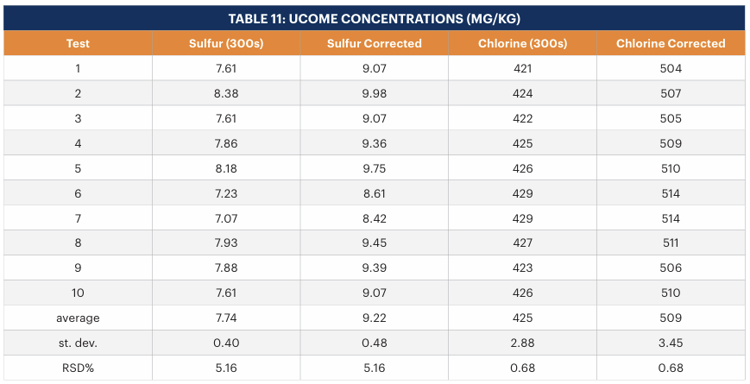
Each sample was measured ten times under repeatability conditions; condition of measurement, out of a set of conditions that includes the same measurement procedure, same operator, same measuring system, same operating conditions, and same location, with replicate measurements on the same or similar objects over a short period of time. Each sample was separated into ten aliquots via pipette into ten standard XRF cups. The samples were then sealed with Etnom® sample film, placed into Sindie +Cl, and measured for 300 seconds on a mineral oil calibration curve.
NOTE: It is possible to optimize the accuracy and precision of the results by using a custom calibration range suited to your product streams. It is also possible to calibrate in matrix removing the need for correction factors all together. This can be done by using methyl oleate or other oxygen-containing and sulfur-free blank solutions in accordance with ISO 20884.
Results
For each biodiesel sample, the oxygen content has been calculated from the ester composition, which was obtained via GC (Gas Chromatography) analysis. The results can be found in Table 1 together with the correction factor that should be applied per element/sample. Tables 2 and 3 display the oxygen correction factors for samples containing 0-19 wt% oxygen measured on a mineral oil calibration. Note that these factors are specific to the analyzer geometry of the Sindie® and Clora® analyzer series.
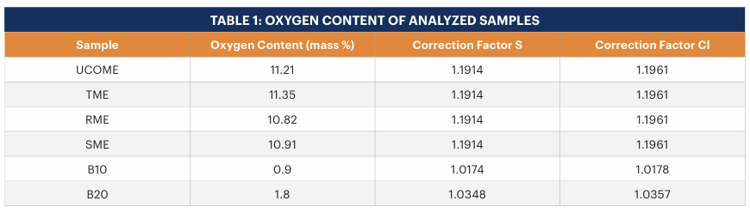
Normally B10 and B20 are not corrected as their oxygen content is below 3.7% even when 10% or 20% biodiesel has been added. However, it’s possible to have a blend where 30% to 50% of the product is biofuel. The reason B10 and B20 are also corrected is to indicate the effect of a low percentage of oxygen and how it scales up when the percentage increases, especially with the rise of the new Biofuel Oils (BFO) which can contain up to 30% biofuel or more. In recent news, companies have promoted the use of 100% second generation biofuels being used as fuel for their trucks, ships and even airplanes. Sindie +Cl is also suited to test these biofuels.

NOTE: To determine the appropriate correction factor, select the row that matches the most significant figure of the oxygen concentration and then find the column that matches the least significant figure. The intersection of the row and the column is the correction factor. For example, a sample with an oxygen concentration of 11 wt% would use a correction factor of 1.1914. The correction factor is applied by multiplying the measured result by the correction factor to obtain the oxygen corrected sulfur value.

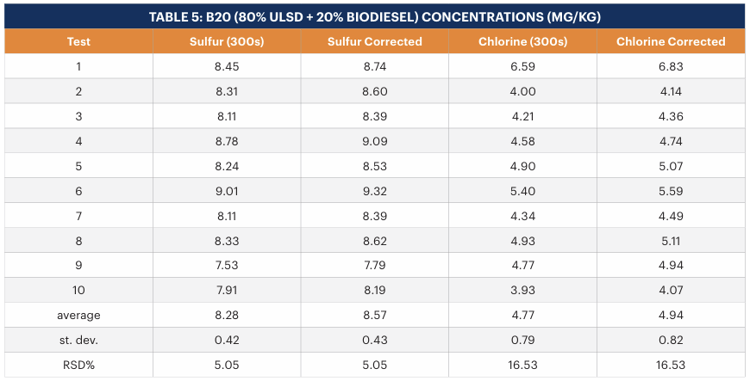
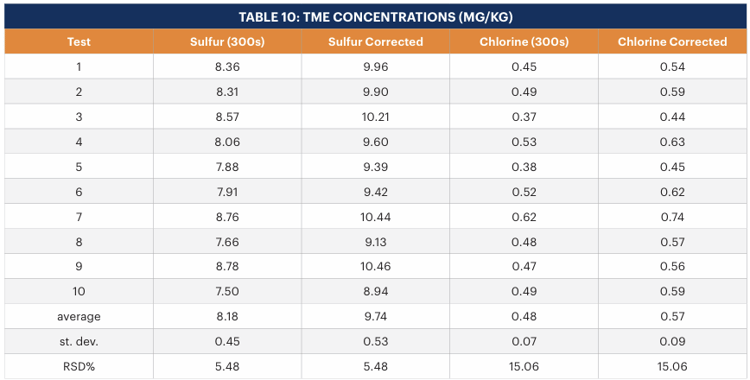
NOTE: Similar to Table 2, to determine the appropriate correction factor, select the row that matches the most significant figure of the oxygen concentration, and then find the column that matches the least significant figure. The intersection of the row and the column is the correction factor. For example, a sample with an oxygen concentration of 11 wt% would use a correction factor of 1.1961. The correction factor is applied by multiplying the measured result by the correction factor to obtain the oxygenated correction chlorine value. Once the samples were analyzed, data was compiled for each sample as shown in Tables 4 through 12.
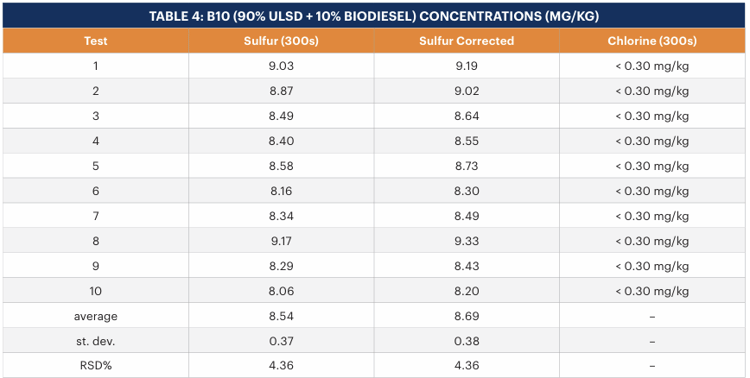
NOTE: The chlorine content for this particular B10 blend is very low. This sample has also been measured on Clora 2XP for 300 seconds which resulted in a concentration of < 0.07 mg/kg.
Product Highlight: Sindie +Cl/Sindie%20+Cl%20on%20white.png?width=250&height=250&name=Sindie%20+Cl%20on%20white.png)
Two Critical Elements with One Instrument
Sindie ® +Cl is a two-in-one instrument enabling trace analysis of both sulfur and chlorine with one analyzer. It is the ideal solution to certify sulfur levels in finished products, assess chlorine for corrosion mitigation, and optimize process parameters.

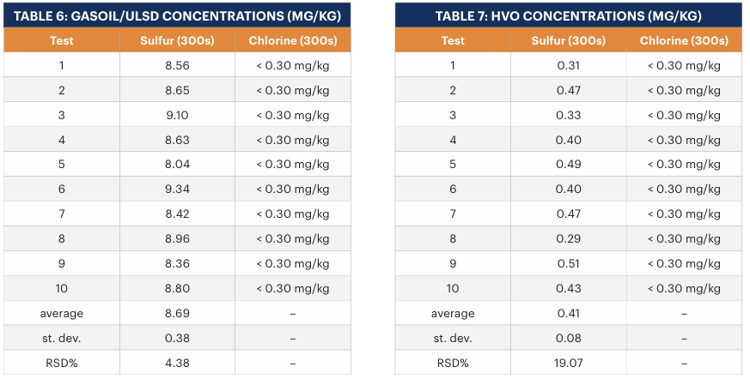
NOTE: The chlorine content for this particular gasoil/ULSD blend is very low. This sample has also been measured on Clora 2XP for 300 seconds, which resulted in a concentration of < 0.07 mg/kg.
NOTE: The chlorine content for this particular HVO sample is very low. This sample has also been measured on Clora 2XP for 300 seconds, which resulted in a concentration of < 0.07 mg/kg.
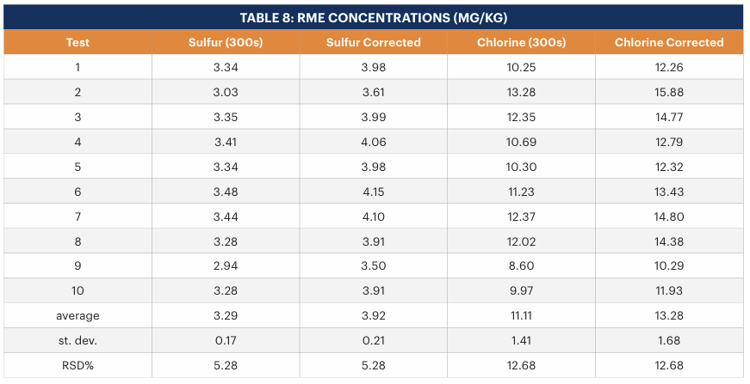
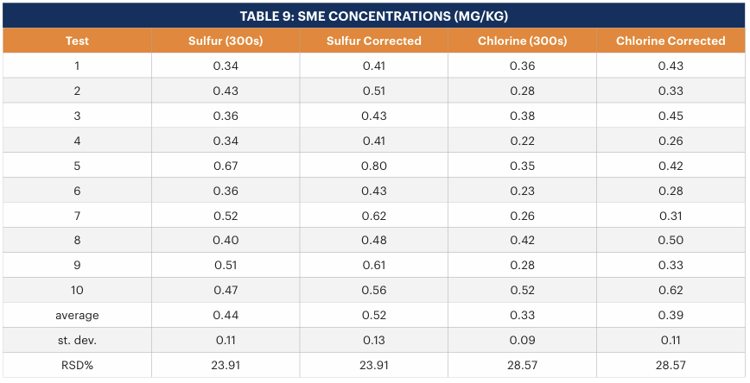
NOTE: ASTM D2622 has a sulfur scope of 3 mg/kg to 4.6 wt% of total sulfur. ISO 20884 has a sulfur scope of 5 to 500 mg/kg. The sulfur concentration of this sample is below the scope; yet Sindie +Cl is still able to get reliable data. If a better precision is required at this level, our Sindie Gen 3 model has an LOD of 0.15 mg/kg in mineral oil for sulfur at 300 seconds.
Conclusion
With the continued development of biofuels and a push for higher concentrations in traditional fuels, petroleum professionals are looking to utilize technology that delivers rapid and accurate results for on-site biofuel measurement. Sindie +Cl is a viable solution, delivering total sulfur and chlorine in one measurement without the need for a matrix-matched calibration by simply applying a correction factor to the results. This allows professionals to certify their biofuel products more efficiently than with other methods. Sindie +Cl complies with ASTM D2622 and therefore meets the regulatory limit of ASTM D6751 and ASTM D7467. It also meets the precision requirements for ISO 20884 and can be used for EN 14214.

Using MWDXRF to Measure Sulfur & Chlorine in Biofuels
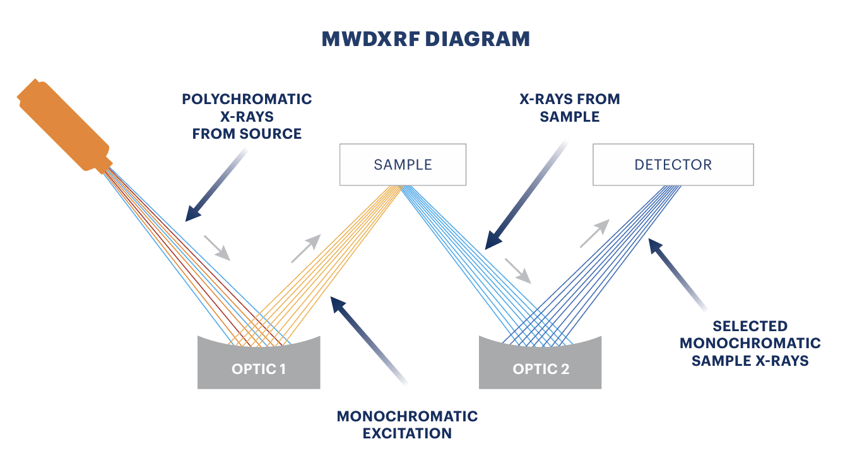
XOS’ proprietary technology, known as Monochromatic Wavelength Dispersive XRF (MWDXRF®) utilizes high performing doubly curved crystal (DCC) optics coupled with a low-power X-ray tube creating a low maintenance, highly precise technology. MWDXRF is a simplified and highly robust X-ray technique which provides sub-1 ppm sulfur and chlorine detection. An MWDXRF analyzer engine consists of a low power X-ray tube, a point-to-point focusing optic for excitation, a sample cell, a second focusing optic for collection and an X-ray detector. The first focusing optic captures a narrow bandwidth of X-rays from the source and focuses this intense, monochromatic beam to a small spot on the sample cell. The monochromatic primary beam excites the sample and secondary characteristic fluorescence X rays are emitted. The second optic collects only the characteristic sulfur and chlorine X-rays and focuses them on the detector. The analyzer engine has no moving parts and does not require consumable gasses or high temperature operations. MWDXRF removes the scattered background peak created by the X-ray tube increasing the signal-to-background ratio (S/B) by a factor of 10 compared to conventional WDXRF technology. The S/B is improved by using the monochromatic excitation of the X-ray source characteristic line. Additionally, the focusing ability of the collection optic allows for a small-area X-ray counter, which results in low detector noise and enhanced reliability.
About the Author 
Julian D. van Berkum is the Technical Sales and Application Specialist at XOS, bringing over a decade of laboratory experience since 2011, including roles from chemical analyst to lab manager. He specializes in renewable fuel analysis, using MWD-XRF solutions to help customers achieve accurate results. Julian is an active member of ISO, CEN, and NEN committees, contributing to industry standards. With a practical understanding of lab techniques and a customer-focused approach, he is a valuable resource for clients aiming to improve their measurements.
.png?width=600&height=323&name=Technology%20Spotlight%20Monochromatic%20Micro%20X-ray%20Fluorescence%20(M%CE%BCXRF).png)
%20(1).png?width=600&height=323&name=Technology%20Spotlight%20Micro%20X-ray%20Fluorescence%20(%CE%BCXRF)%20(1).png)