

Background
Petroleum Coke (also referred to as petcoke), a byproduct of the oil refining process, is typically sold and used as either fuel or material for anodes in the aluminum and steel industries, amongst others. However, petcoke may contain high levels of sulfur and a variety of metals which have the potential to cause fouling and damage to both the environment and refining equipment. In addition, high sulfur and/or metal content in petcoke reduces its usefulness for certain applications, which in turn reduces its value. Similarly, mined coal may contain varying levels of sulfur which will determine its quality and uses, and thus its value.
Challenge
Though there are a number of existing ASTM and ISO test methods available to determine the elemental concentrations of the sulfur and metal content in petcoke and coal, these methods require significant sample preparation and specialized operator skills. Such methods can be difficult and time-consuming, and the time from sample prep to results can take hours. In addition, some of these methods require ashing of the product prior to analysis which uses specialized gases. These sample preparation steps are time consuming and require additional reagents. When ashing a sample, you may not receive a true representation of the composition of the raw material. Other methods, including XRF, require the fusing, blending and pressing of the sample into pellets or tablets which requires additional reagents, processing time, equipment and specialized training.
Solution
Petra MAX, an elemental analyzer powered by monochromatic EDXRF, provides a unique vertical sample introduction system and delivers precise and fast measurement of sulfur and metals in powder matrices with minimal sample preparation. This is an ideal solution to determine the sulfur and metal content in petcoke and coal, with sample preparation being easy to master and results in as little as 5 minutes. Throughout this paper, we will review the results from recent studies of petcoke and coal using Petra MAX.
Experiment
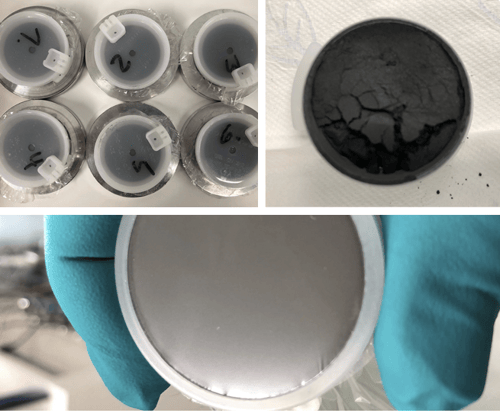
Both the petcoke and coal samples were ground, mixed and prepared into standard XRF cups with Etnom® film. For best results, XOS recommends grinding the sample to 325 mesh or finer. Fill the sample cup to at least ¾ full, apply the film, and then tap the samples on their sides, as shown in Figure 1. Tapping the sample helps to compress the powder to minimize air gaps between particles, which can impact results. Petra MAX’s vertical sample system allows for better compaction of powdered samples without bowing the film. In addition, the sample system is beneficial for hydrocarbon samples as it directs the sample spills away from critical components, such as the detector, and into a drip tray.
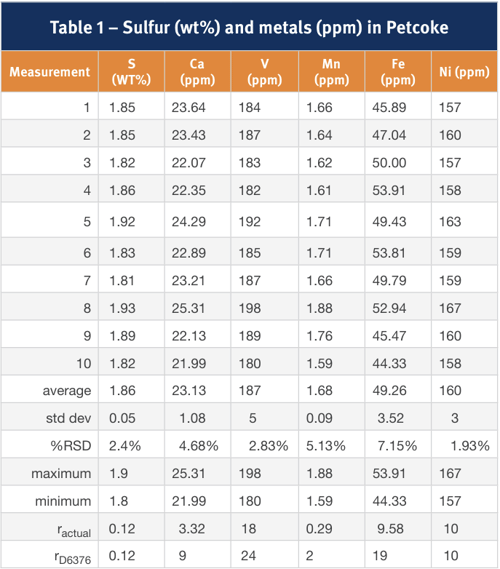
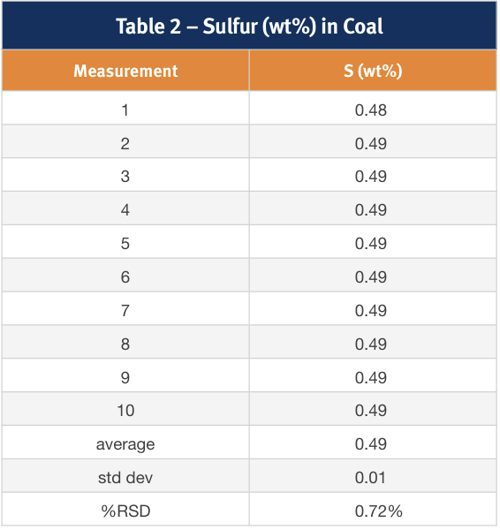
The samples were analyzed ten times for 300s using repeatability conditions. Between repeat measurements, the sample film was replaced on the sample cup, and then the sample cup was shaken and tapped before placing it back in the analyzer. See Tables 1 and 2 for results.
Product Highlight: Petra MAX/Petra%20MAX%20on%20white.jpg?width=327&height=327&name=Petra%20MAX%20on%20white.jpg)
Rapid sulfur measurement plus 12 other critical elements
Petra MAX delivers advanced elemental analysis powered by EDXRF, utilizing XOS's patented doubly curved crystal optics coupled with a high-performance silicon drift detector and an intense monochromatic excitation beam. This industry-leading technology reduces background noise and increases signal-to-noise output, enabling low detection limits and high precision. Petra MAX offers low-level detection of iron, saving the marine industry money on engine replacement and lube oil costs, while also using a next-generation interface that saves users time.

Figure 1
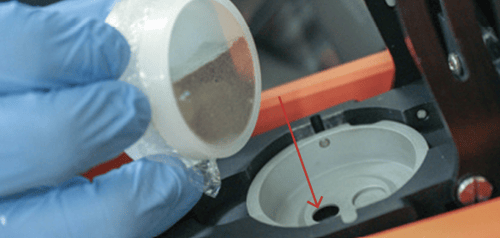
For best results when using Petra MAX, it is recommended that the cup be almost completely filled prior to applying the film. This will result in the cup being at least 50% full in the vertical position after tapping to remove the air gaps so that the compacted powdered sample is within the analyzer focal point (which is about ⅓ of the way up from the bottom edge of the cup, as indicated by the hole in the sample basket in Figure 1). Lastly, if using Petra MAX Autosampler, it is recommended to run only one petcoke or coal sample at a time using a vent clip so that the ground, packed sample remains in the correct orientation and packed tightly throughout the analysis.
Figure 2: Ground Samples Used in Experiment
Results
The measurement results in Table 1 demonstrate precise results as evidenced by a low relative standard deviation (%RSD) of <10% for each of the measured elements. The repeatability of Petra MAX can be compared with ASTM D6376 repeatability. Although Petra MAX does not comply with this method, as D6376 is a wavelength dispersive XRF method (WDXRF), Petra MAX does demonstrate repeatability that is within the method precision. This can be observed by comparing the ractual which is the difference between the maximum and minimum measurement values for each element, with the calculated D6376 precision (rD6376), both of which are listed in Table 1. The data in Table 2 shows a very similar high level for precision of sulfur in coal with an RSD of less than 1%.
 Petra MAX was calibrated with a combination of
LECO and NIST sulfur and coal standards prior to analysis.
Conclusion
The results from both studies demonstrate that Petra MAX delivers precise results for sulfur in coal, as well as sulfur and metals in petcoke. This solution does not require the complex sample preparation, specialized skills, and additional chemicals and reagents as other methods and techniques. In addition, you can achieve results in 5 minutes or less—an ideal screening solution for these applications.

Sample Preparation
For similar powder applications, we typically recommend three repeat determinations at 100s, and then each be averaged and reported as a single result. While this is true when analyzing samples with percent level components, it is less applicable when the desired measurement components are present at ppm level concentrations. This is because a 300s measurement time is recommended for lower concentrations to achieve accurate measurements. If measurement time is not of concern, the average of three 300s determinations can be used to obtain a more precise and accurate measurement. If the sample is only being measured for percent level sulfur, a 100s measurement time is sufficient. In this case, use the average of three 100s determinations as a single test result. See below for procedural details.
XRF analyzers function best when analyzing homogenous samples, as the measurement results come from a relatively small focal point on the sample. For finished liquid hydrocarbon fuels, such as diesel or gasoline, this is generally not an issue as they tend to be homogeneous. Unfortunately, petcoke and coal tend to be inherently non-homogenous, which is why it is necessary to grind the sample to a fine powder and mix as well as possible before analysis. However, even grinding the powder to a very fine mesh size and mixing thoroughly may not be enough to ensure consistent results, especially if the sulfur or metals are still not evenly distributed in the sample. For this reason, in addition to grinding, mixing and tapping to remove air, the following procedure can be used to improve overall data quality for powder matrices:
-
Prepare the sample using the recommended practices described above. Tap the sample on its side to compress the powder and eliminate air gaps, then introduce into Petra MAX in the correct orientation (using a vent clip for autosampler analysis). Measure for 300s for both trace metals and sulfur, or 100s if only measuring for sulfur.
-
Prepare a second sample following the same process as above, or, using the first sample, shake to mix the powder, then re-tap the sample as before. Insert into Petra MAX and measure for 300s or 100s.
-
Prepare a third sample or reanalyze the first sample again using the procedure above.
-
Report the average of the three determinations as the measurement result. This will ensure that the user gets a more accurate value, that is, a value that is more consistent with the true value of the entire sample.

.png?width=600&height=323&name=EDXRF%20(1).png)