
Background
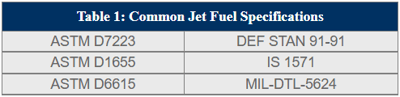
The International Air Transport Association (IATA) reports that in 2017 alone, more than 4 billion passengers traveled by air. It is estimated that air transport will reach global growth of over 7 billion passengers by 2035. Standard jet fuel specifications are used to ensure that wherever a plane is fueled, it can continue to operate safely. Common jet fuel specifications are shown in Table 1. Jet fuel specifications require total sulfur content to be less than 0.30 wt%. In order to comply, refinery and independent laboratories rely on standard test methods such as ASTM D4294 and ISO 8754. These labs operate in fast-paced environments that require rapid, precise results and are increasingly relying on solutions that provide simple and direct integration with Laboratory Information Management Systems (LIMS).
In this study, certified standards were analyzed to demonstrate the expected performance of Petra utilizing ASTM D4294 methodology for jet fuel.
- Sulfur in mineral oil standards were used to calibrate following ASTM D4294 and ISO 8754 methods using a single curve from 10 ppm to 6.0 wt%
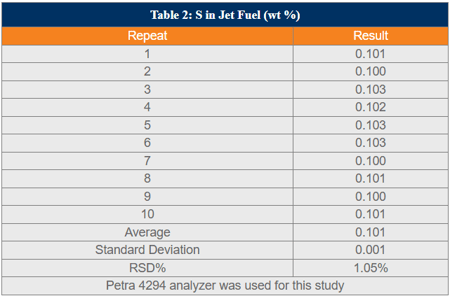
- A certified standard in a matrix similar to jet fuel with a concentration of 0.1 wt% was obtained
- Samples were prepared by transferring 7 mL to a 43 mm XRF sample cup and sealed with Mylar film
- Separate aliquots were prepared and analyzed for 100 seconds each
- Individual measurement results and average are reported in Table 2
Product Highlight: Petra MAX/Petra%20MAX%20on%20white.jpg?width=327&height=327&name=Petra%20MAX%20on%20white.jpg)
Rapid sulfur measurement plus 12 other critical elements
Petra MAX delivers advanced elemental analysis powered by EDXRF, utilizing XOS patented doubly curved crystal optics coupled with a high-performance silicon drift detector and an intense monochromatic excitation beam. This industry leading technology reduces background noise and increases signal-to-noise output, enabling low detection limits and high precision. Petra MAX offers low-level detection of iron, saving the marine industry money on engine replacement and lube oil costs, while also using a next-generation interface that saves users' time.

Conclusion
Sulfur analysis using ASTM D4294 and ISO 8754 continues to be an important measurement for refinery and independent laboratories certifying jet fuel around the world. The growing demand for air travel will continue to drive the need for a rapid and precise analysis solution. That solution is Petra — delivering accurate measurement for jet fuel and other hydrocarbons without the need for complex sample preparation or consumable gasses.