.png)
Micro X-ray Fluorescence (μXRF) has emerged as a game-changing tool in archaeology, offering non-destructive analysis of artifacts and materials. By revealing the elemental composition and distribution of objects, μXRF provides invaluable insights into their origins, production techniques, and historical significance. Recent advancements, particularly the integration of polycapillary optics, have elevated the capabilities of μXRF systems, enabling faster, more precise analysis.
The role of polycapillary optics in μXRF advancements
Traditional μXRF systems relied on pinhole collimators, which limited spatial resolution and measurement speed. The introduction of polycapillary optics has revolutionized the field, allowing X-rays to be focused into fine beams. This innovation has significantly improved data quality and measurement speed, making high-resolution elemental mapping more accessible. Today, polycapillary optics are a cornerstone of modern μXRF systems.
Curved-Surface μXRF: A Breakthrough in Artifact Analysis
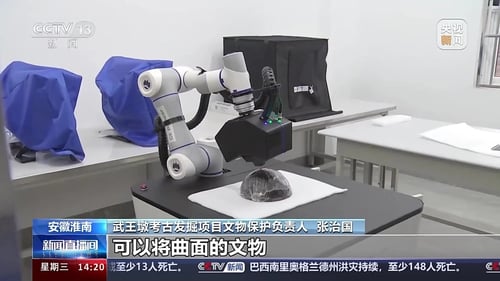
While most commercial μXRF instruments are limited to flat surfaces, researchers at the Institute of High-Energy Physics (IHEP) under the Chinese Academy of Sciences (CAS) have developed a groundbreaking curved-surface μXRF system. Equipped with XOS polycapillary optics, this system enables 3D analysis of irregularly shaped objects, opening new possibilities for archaeological research. Project lead, Dr. Qiong Xu, shares details in an interview with Chinese news channel CCTV-13:
“We deployed a piece of equipment called a curved surface micro-area X-ray fluorescence spectrometer, which allows us to scan the elemental distribution of curved artifacts. This helps overcome the limitations of the naked eye, especially in cases where the manufacturing techniques are difficult to discern. To my knowledge, this is the first time such a device has been used at an archaeological site.”
By integrating imaging technology, artificial intelligence, and advanced quantitative algorithms, the curved-surface μXRF system delivers unparalleled analysis of delicate artifacts. According to Xu, the system’s software can be adapted for broader applications in industries such as EV batteries, semiconductors, and pharmaceuticals.
Product Highlight:
Polycapillary Optics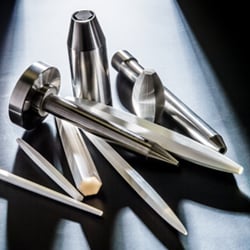
Improve X-ray analysis performance and capability
A polycapillary optic captures a large solid angle of X-rays from an X-ray source and redirects them to a micron-sized focal spot or a highly collimated beam. The X-ray intensity achieved with such optics is a few orders of magnitude higher than that obtained with conventional pinhole collimators, contributing to the significantly improved X-ray analysis performance in detection sensitivity, spatial resolution, measurement speed, and precision. XOS optics are widely used in commercial instruments and customized X-ray analysis systems for various industrial and research applications in the fields such as microelectronics, semiconductor
manufacturing, pharma, and life sciences.

Applications of μXRF in Archaeology
Artifact Analysis
μXRF is widely used to study ceramics, glass, metals, and pigments, helping researchers identify raw material sources and manufacturing techniques.
Provenance Studies
By analyzing the elemental composition of materials like obsidian or pottery, archaeologists can trace ancient trade routes and cultural exchanges.
Cultural Heritage Preservation
The non-destructive nature of μXRF makes it ideal for analyzing delicate artifacts, ensuring their preservation for future generations.
Collaborations Driving Innovation: IHEP and XOS Partnership
The success of the curved-surface μXRF system is a testament to the collaboration between IHEP and the X-ray optics team at XOS. By optimizing optic design and system integration, the partnership has delivered multiple polycapillary optics to build prototype systems. These systems are now being used by major museums and archaeological research institutes in China, further advancing the field.
Conclusion: The Future of μXRF in Archaeology and Beyond
The integration of polycapillary optics and the development of the curved-surface μXRF system have revolutionized artifact analysis, enabling researchers to uncover new insights into history and culture. As this technology continues to evolve, its applications are expanding beyond archaeology into industries like microelectronics and pharmaceuticals. With ongoing innovation and collaboration, the future of μXRF technology is brighter than ever.

.png?width=600&height=323&name=Technology%20Spotlight%20Energy%20Dispersive%20X-ray%20Fluorescence%20(EDXRF).png)
.png?width=600&height=323&name=Technology%20Spotlight%20Wavelength%20Dispersive%20X-ray%20Fluorescence%20(WDXRF).png)