%20vs.%20XRF%20(D8252)%20for%20Ni%20and%20V.png)
Background
Crude oil can naturally contain metals like nickel (Ni) and vanadium (V). These metals need to be monitored due to their negative effects on refining processes. For example, nickel rapidly deactivates process catalysts used in hydrotreaters and FCC units which leads to off-specification coke and increased, unplanned costs to refiners.
In the face of tightening regulations and increased demand for sweeter crudes, refiners are looking to buy lower cost oils that contain minimal amounts of the metals mentioned above, with the intent of assessing their concentration levels throughout the refining process.
In addition to this, NYMEX regulations for sweet crude were made more stringent January 2019 to lower the acceptable limits to 8ppm and 15ppm max, for nickel and vanadium respectively. Currently NYMEX specifies that refineries and other petroleum certification sites, such as terminals and third-party labs, must utilize method ASTM D5708B1 to determine these two elemental concentrations.

ASTM D5708B
ASTM D5708B is an older (1995) and widely used method that uses Inductively Coupled Plasma Optical Emission Spectroscopy (ICP – OES) test method (IP 501/IP 621 European equivalent). Samples must be digested with sulfuric acid, constantly stirred under gentle heat, then burned off in a muffle furnace to remove the carbon. After this, the sample must be reconstituted with nitric acid before finally being analyzed.
ICP analysis is widely accepted and sensitive form of elemental quantification; however, it involves exhaustive sample preparation and lengthy wait times for results—usually between 6 to 12 hours. Although ICP is currently the specified method, there is an alternative method that many are using for screening that covers these two elements, has a greater range, measures faster, and is typically more precise than the ICP method D5708B.
ASTM D8252
ASTM D82522 is an X-ray Fluorescence (XRF) method that is gaining traction in the crude oil industry. This method involves exposing the sample to X-rays to produce an emission at an energy level that is characteristic of the element(s) of interest and covers both Energy Dispersive XRF (EDXRF) and Wavelength Dispersive XRF (WDXRF). The main advantage to this method is how quickly results are given and how simple it is to prepare a sample (see product spotlight on Petra MAX, XOS’ D8252 compliant EDXRF analyzer).
Despite not being the specified method, several locations are adopting D8252 to screen samples. This is incredibly useful for several reasons, the first being that to perform D5708B it is required to know the rough concentration of the metals in your sample and D8252 removes this guess work. Another reason screening is useful is due to the fluid nature of the business; it pays to know that there is an issue as soon as it is happening, not 8 hours after the fact. With D8252, a sample can be flagged before ICP analysis, potentially saving thousands of dollars and preventing countless headaches. So, the question remains, how do these two methods compare to one another?

A Crude Analysis
ASTM runs a crude oil Proficiency Testing Program (CO PTP) in which they send out samples of crude oil three times a year to be tested at independent labs and refineries around the world.3 The program then publishes statistics from the test results, including data on Ni and V by D8252 and D5708B. Since D8252 is a relatively new method, published in 2019, it has only been included in the CO PTP since 2021.
Since its inauguration, there have been 6 rounds of testing completed, and participation has nearly doubled from 6 to 11 labs (as compared to an average of 40 ICP labs). Before diving into that data, let’s look at the method scopes in more detail.

Table 1 shows the concentration ranges of the method scopes for both D5708 and D8252. Note the D5708 concentration ranges for vanadium and nickel compared to the maximum allowed concentration stated by the NYMEX specification. The NYMEX max specification (8 & 15PPM) is below the scope of D5708 for both nickel (10-100PPM) and vanadium (50-500PPM).
The D8252 range goes considerably lower than the NYMEX specs, with the lower range of 2.2 PPM and 1.9 PPM for nickel and vanadium respectively, as seen in Table 1. This begs the question; how can I certify that my crude is light sweet if the maximum acceptable value for nickel and vanadium are outside the scope of the required method?
Figure 1 - D8252 vs D5708B Nickel (PPM) CO PTP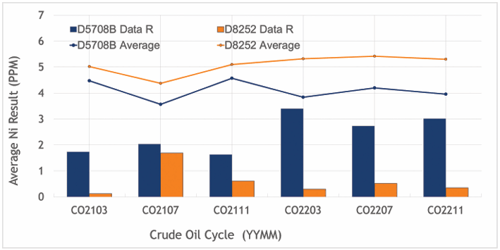
Figure 2 - D8252 vs D5708B Vanadium (PPM) CO PTP 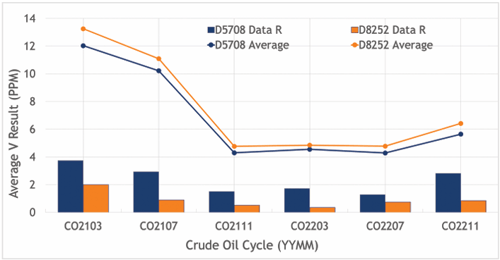
Crude Oil PTP Data Comparison
See Figures 1 & 2 for a comparison of average concentration and data reproducibility for the two methods. The two graphed lines on Figures 1 & 2 represent the average elemental concentration from each program cycle using D5708B or D8252. Note that D5708B (blue lines) biases low when compared to D8252 (orange lines). The primary reason for this is that D8252 will always provide results that are the TOTAL concentration of Ni/V, Whereas ICP, due to complex, multi-step sample preparation, can often provide a lower result due to incomplete sample digestion. There is a significant difference in sample preparation and measurement of the two methods. D8252 requires minimal sample prep, it’s as simple as filling a cup, applying the film, and measuring, the physical state of the sample never changes. In contrast, D5708B requires near complete consumption of the sample: decomposition with acid, drying, ashing, then digested and reconstituted with acid. Every time the sample must be handled during a measurement process, the chances for human error and incomplete recovery increase. For these reasons, ICP results tend to bias lower.
When we change our focus to reproducibility, the difference between the two methods is seen in the bar graphs in Figures 1 & 2. Reproducibility is the difference between measuring the same sample at two laboratories, using different instruments and operators. In essence, the larger the reproducibility value, the larger the variance between two laboratories measuring the same sample. D8252 consistently has better reproducibility or precision than D5708B, especially for nickel. D8252 has less variation from one lab to another due to there being much less sample preparation and handling. The more steps there are in a process, the greater variability there will be from one measurement to another.
Product Highlight: Petra MAX/Petra%20MAX%20on%20white.jpg?width=327&height=327&name=Petra%20MAX%20on%20white.jpg)
Rapid sulfur measurement plus 12 other critical elements
Petra MAX delivers advanced elemental analysis powered by EDXRF, utilizing XOS patented doubly curved crystal optics coupled with a high-performance silicon drift detector and an intense monochromatic excitation beam. This industry leading technology reduces background noise and increases signal-to-noise output, enabling low detection limits and high precision. Petra MAX offers low-level detection of iron, saving the marine industry money on engine replacement and lube oil costs, while also using a next-generation interface that saves users' time.

Conclusion
Changes in crude specifications have resulted in an increased importance of monitoring nickel and vanadium. D8252, a much newer method, can consistently perform at lower concentrations to test light sweet crudes, instead of D5708B, which has a method precision statement that is nearly 30 years old and is used at concentrations outside of the published ranges. Even though D5708B may be considered the industry standard, new ASTM methods have grown in popularity.
The ASTM CO PTP program demonstrates that D8252 shows good correlation with ICP for nickel and vanadium in crude oil, with better precision, as well as the trend that more and more labs are using D8252 either by itself or in tandem with D5708 method B.
1 “Standard Test Methods for Determination of Nickel, Vanadium, and Iron in Crude Oils and Residual Fuels by Inductively Coupled Plasma (ICP) Atomic Emission Spectrometry.” ASTM International - Standards Worldwide, ASTM.org, 8 July 2020, https://www.astm.org/d5708-15r20e01.html.
2 “Standard Test Method for Vanadium and Nickel in Crude and Residual Oil by X-Ray Spectrometry.” ASTM International - Standards Worldwide, ASTM.org, 1 Oct. 2019, https://www.astm.org/d8252-19e01.html.
3 “Crude Oil Proficiency Testing Program.” ASTM International - Standards Worldwide, ASTM.org, https://www.astm.org/ptpco2023.html
4 “Chapter 200 Light Sweet Crude Oil Futures - CME Group.” NYMEX Rule Book, https://www.cmegroup.com/content/dam/cmegroup/rulebook/NYMEX/2/200.pd
%20vs%20ICP%20(IP%20501%20%26%20IP%20621).png?width=600&height=323&name=Precision%20Comparison%20Case%20Study%20%E2%80%94%20Petra%20MAX%20(EDXRF%C2%AE)%20vs%20ICP%20(IP%20501%20%26%20IP%20621).png)