Summary
Why 3.0 µm Etnom Film Needed a Replacement for Petra MAX Use
Historically, 3.0 µm Etnom film served as the sample film for Petra MAX analyzers. Following the discontinuation of 3.0 µm Etnom film by Chemplex in June 2026, alternative film options were evaluated to identify a suitable replacement while maintaining the analytical performance of Petra MAX, as well as handleability for cup assembly
Two candidate replacement films, 6.0 µm polypropylene (PP) and 3.0 µm polyester (PET), were identified following the screening of multiple film types and thicknesses and were subsequently evaluated against 3.0 µm Etnom, which served as the control throughout the study. The overall evaluation included multiple studies assessing analytical performance, film transmissivity, and practical use considerations. The primary objective was to determine which candidate alternative film could provide the best performance.
As part of this broader evaluation, a customer-provided raw crude oil sample containing sulfur (S), iron (Fe), nickel (Ni), and vanadium (V) was analyzed to compare the performance of the candidate films under representative application conditions. This application note highlights the results of the crude oil study, one component of the overall film evaluation program, which supported the selection of 6.0 µm PP as the recommended replacement for 3.0 µm Etnom film in Petra MAX applications.
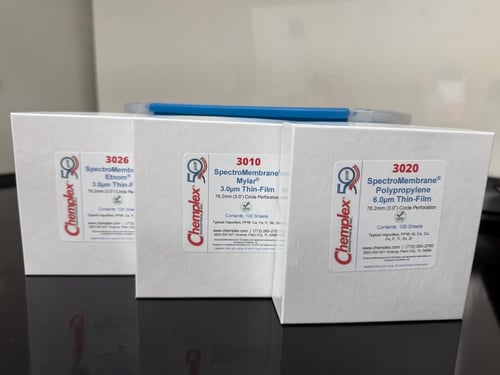
3.0 µm Etnom control, 3.0 µm polyester (PET), and 6.0 µm polypropylene (PP)
Experiment: Candidate Films Evaluated for Petra MAX
Crude Oil Study Design and ASTM Methods
For this study, a customer-provided raw crude oil sample containing sulfur (S), iron (Fe), nickel (Ni), and vanadium (V) was used. Three Petra MAX analyzers were calibrated each using a different sample film: 3.0 µm Etnom, 3.0 µm polyester (PET), or 6.0 µm polypropylene (PP). The same film was used for both calibration and subsequent sample analysis.
Forty aliquots of the crude oil sample were prepared and analyzed on each instrument using the Default Fundamental Parameter (FP) calibration. This approach enabled a direct comparison of the candidate replacement films to the 3.0 µm Etnom control while maintaining consistent calibration and measurement conditions. Analytical performance was assessed using Relative Standard Deviation (%RSD) and method repeatability. Repeatability was evaluated using ASTM D4294 for sulfur and ASTM D8252 for nickel and vanadium. ASTM D8252 was also used as a guideline for evaluating iron, although iron is not included within the scope of the method. The performance results presented below are based on all forty sample aliquots analyzed for each film type.
Performance Results for Sulfur, Iron, Nickel, and Vanadium
Relatively comparable %RSD and repeatability performance were observed among the 3.0 µm Etnom, 6.0 µm PP, and 3.0 µm PET films across sulfur, iron, nickel, and vanadium measurements. All sulfur, nickel, and vanadium measurements met the applicable ASTM repeatability requirements, while iron met the ASTM D8252 acceptance criteria, with 95% of measurements satisfying the calculated repeatability limits. Since neither candidate film demonstrated a meaningful performance advantage based on precision or repeatability, film transmissivity for the other elements covered by Petra MAX, particularly phosphorus, became the primary differentiating factors.
Table 1: Summary of Sulfur, Iron, Nickel, and Vanadium Performance by Film Type
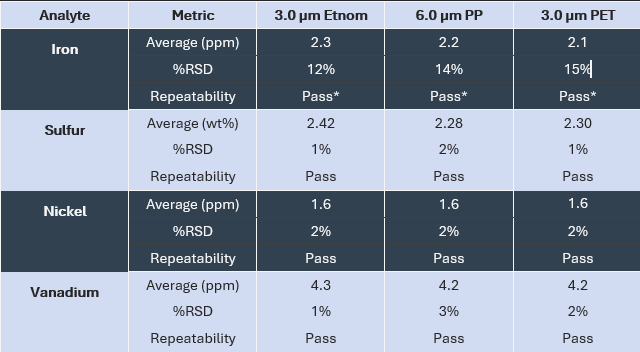
*All but one pair met the calculated repeatability limits, satisfying the ASTM D8252 requirement that at least 95% of results meet the repeatability criteria.
Why 6.0 µm Polypropylene Was Selected
Polypropylene exhibits higher X-ray transmissivity than 3.0 µm polyester (PET) and virtually equivalent transmissivity to 3.0 µm Etnom, resulting in reduced attenuation of fluorescent X-rays passing through the sample film. For phosphorus measurements, 3.0 µm polyester (PET) exhibits approximately 3% lower transmissivity than 6.0 µm polypropylene (PP). Although both candidate films demonstrated comparable %RSD and repeatability performance, the transmissivity characteristics of 6.0 µm polypropylene (PP) more closely align with those of 3.0 µm Etnom, providing an analytical advantage that supported its selection as the preferred replacement candidate.
Product Highlight: Petra MAX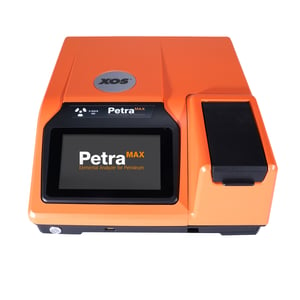
Rapid sulfur measurement plus 12 other critical elements
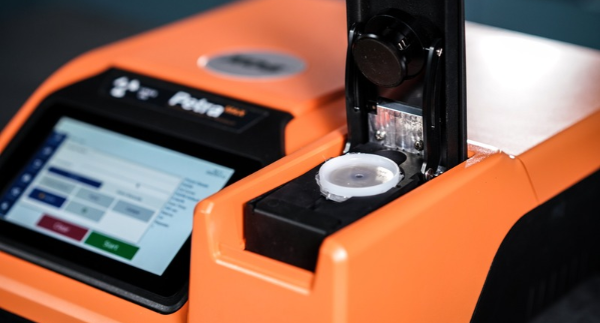
Petra MAX delivers advanced elemental analysis powered by EDXRF, utilizing XOS's patented doubly curved crystal optics coupled with a high-performance silicon drift detector and an intense monochromatic excitation beam. This industry-leading technology reduces background noise and increases signal-to-noise output, enabling low detection limits and high precision. Petra MAX offers low-level detection of iron, saving the marine industry money on engine replacement and lube oil costs, while also using a next-generation interface that saves users time.

Key Takeaways for Petra MAX Users
Following the discontinuation of 3.0 µm Etnom film, two candidate replacement films, 6.0 µm polypropylene (PP) and 3.0 µm polyester (PET), were evaluated as part of a broader film replacement program that included assessments of analytical performance, film transmissivity, and practical use considerations. This application note highlights the results of a crude oil study using a customer-provided sample containing sulfur, iron, nickel, and vanadium. Three Petra MAX analyzers were calibrated using 3.0 µm Etnom, 3.0 µm polyester (PET), and 6.0 µm polypropylene (PP), respectively, and forty aliquots of the crude oil sample were analyzed on each instrument using the default Fundamental Parameters (FP) calibration with a 300-second measurement time. Relatively comparable %RSD and repeatability performance were observed among all three film types across sulfur, iron, nickel, and vanadium measurements.
Because both candidate films met the analytical performance criteria established by the study, film transmissivity served as the deciding factor. Polypropylene exhibits higher X-ray transmissivity than 3.0 µm PET and virtually equivalent transmissivity to 3.0 µm Etnom, resulting in reduced attenuation of fluorescent X-rays passing through the sample film. For phosphorus measurements, 3.0 µm polyester (PET) exhibits lower transmissivity than 6.0 µm polypropylene (PP). While both candidate films demonstrated comparable analytical performance for the primary 4 elements covered by Petra MAX, the transmissivity characteristics of PP supported its selection as the preferred replacement candidate. Based on the results of the overall evaluation program, 6.0 µm polypropylene (PP) is recommended as the replacement for 3.0 µm Etnom film for Petra MAX applications. 3.0 µm Etnom.
About the Author 
Tiobesta Feleke is an Application Scientist at XOS, a manufacturer of MWDXRF and EDXRF analytical instruments. Now in her fifth year with Veralto, she works closely with customers worldwide, providing technical expertise and application support.
Prior to joining XOS, Tiobesta held roles in sales and marketing management in Ethiopia's building materials industry and as a biomanufacturing operator in the pharmaceutical industry. These experiences strengthened her customer-focused approach and technical problem-solving skills.
Frequently Asked Questions
What is the recommended replacement for 3.0 µm Etnom film in Petra MAX?
The recommended replacement for 3.0 µm Etnom film in Petra MAX is 6.0 µm polypropylene (PP). It was selected following evaluation against 3.0 µm polyester (PET) and the 3.0 µm Etnom control.
Why was 6.0 µm polypropylene selected over 3.0 µm polyester?
Although both candidate films showed comparable precision and repeatability, 6.0 µm PP was selected because its X-ray transmissivity more closely matched that of 3.0 µm Etnom. This provided an analytical advantage, particularly for elements such as phosphorus.
Did 6.0 µm PP meet ASTM repeatability requirements?
Yes. For the crude oil study, 6.0 µm PP met the applicable ASTM repeatability requirements for sulfur, nickel, and vanadium, and iron also met the acceptance criteria using ASTM D8252 as a guideline.
Which analytes were evaluated in the crude oil study?
The crude oil study evaluated sulfur (S), iron (Fe), nickel (Ni), and vanadium (V). These analytes were measured across all three film conditions to compare analytical performance.
How did PP and PET compare with 3.0 µm Etnom?
Both 6.0 µm PP and 3.0 µm PET showed broadly comparable %RSD and repeatability performance relative to 3.0 µm Etnom for sulfur, iron, nickel, and vanadium. Neither candidate showed a meaningful precision advantage over Etnom, but PP offered more favorable transmissivity characteristics, which supported its final selection.